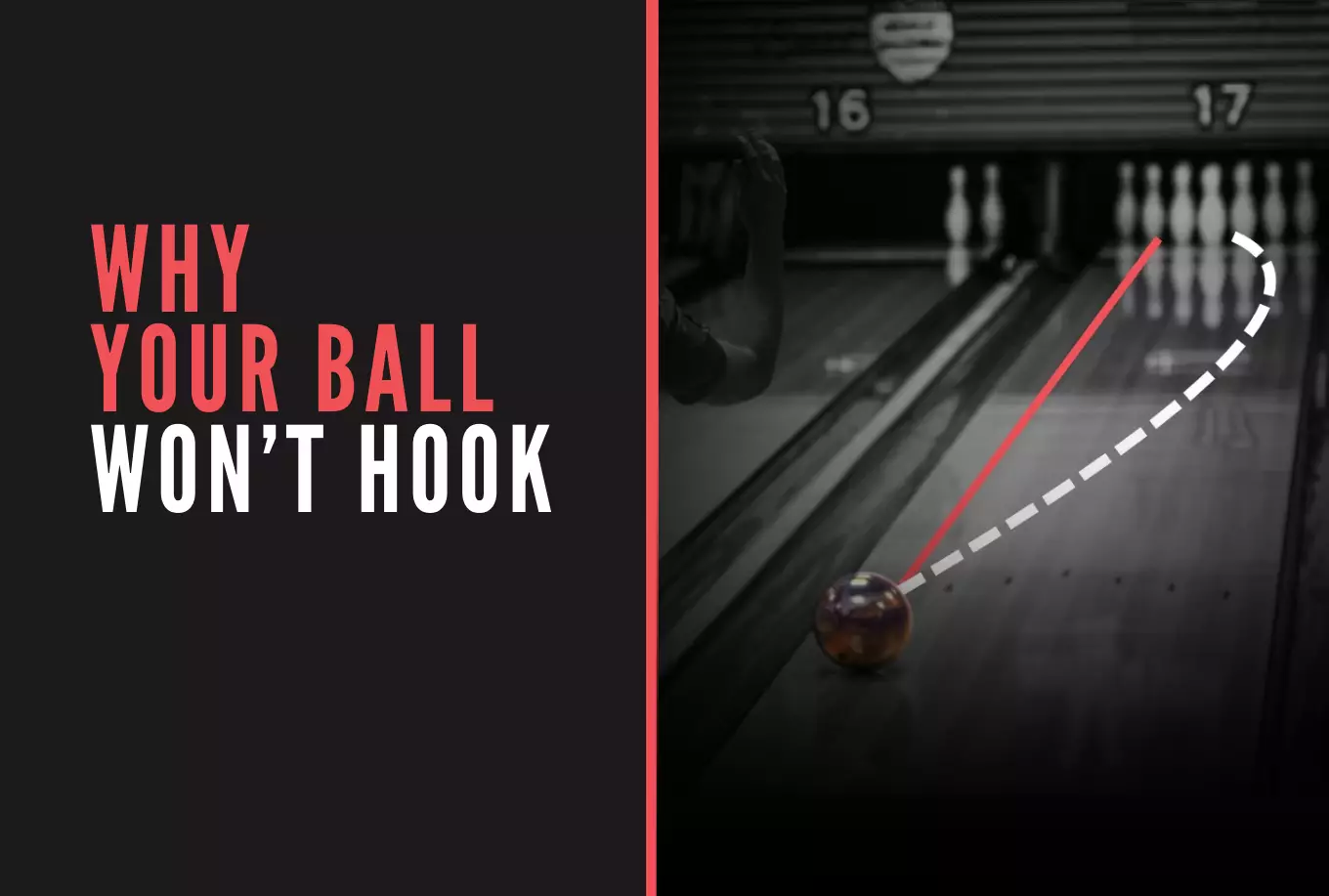
Most bowling balls that will not hook are thrown with the hand behind or under the ball, thrown too fast for the bowler's rev rate, or have a cover with too little friction for the oil on the lane. A plastic house ball, or a reactive ball soaked with oil, will go almost straight no matter how hard you try to spin it.
In most cases it is a release problem first and an equipment problem second.
Hook is friction. The ball skids through the oil at the front of the lane, then grips the drier back end and turns. Anything that cuts friction (a smooth cover, oil in the cover, heavy oil on the lane) or cuts rotation (a hand behind the ball, too much speed) shortens or kills the hook. Once you know which side the problem is on, the fix is usually simple.
Is Your Release or Your Ball the Problem?
The quickest test is to throw a few shots with a different ball. If no ball hooks for you, the problem is your release or your speed. If your ball used to hook and has slowly stopped, the problem is probably the ball or the lane.
Why Your Ball Is Not Hooking
Bowling.com lists the most common release faults when a ball will not hook even though the bowler is trying to rotate the wrist: gripping too tightly, the thumb not leaving the ball before the fingers, over-rotating or cranking the wrist, throwing too hard and poor swing timing.
The first thing I usually check is my own hand at the end of the swing. If my palm is facing the pins and the follow-through feels forced, I already know the ball is going to go straight, whatever ball I am throwing.

Are You Throwing a House Ball?
If you are bowling with a house ball, that is very likely the reason it does not hook. House balls have plastic (polyester) covers that create very little friction with the lane.
On top of that, house balls are usually drilled for a conventional grip, with your fingers deep in the holes, so it is hard to rotate the ball at release. The three main cover types compare like this:
- Plastic: little friction, little hook. Great for spares, which is why many bowlers keep one as a spare ball.
- Urethane: moderate, smooth hook, less affected by oil changes.
- Reactive resin: the strongest hook, but it absorbs oil and needs regular cleaning.
Our guide to what bowling balls are made of explains the coverstock types in more detail. If you want a ball that hooks, the first real step is your own reactive or urethane ball drilled for your hand.
Does Ball Speed Stop a Bowling Ball from Hooking?
Yes. A ball thrown too fast for its rev rate skids through the part of the lane where it should start turning, so it hooks late or not at all. Slowing down a little gives the ball more time to grip.
Looking at ball speed and rev rate together, MOTIV gives average numbers of about 17 to 18 mph and about 325 rpm (300 to 350 counts as average). It describes bowlers who throw over 17 mph with fewer than 300 rpm as "speed dominant": their ball reads the lane late and they need stronger, earlier-hooking equipment. MOTIV's rule of thumb is that speed and revs are in balance at about 50 rpm for every 1 mph.
Speed and Rev Rate in Balance
The rev rate that matches each ball speed, and what happens if yours is lower.
Speed numbers depend on where they are measured. The ball is fastest at release and loses about 3 to 3.5 mph on the way to the pins. Our guide on bowling ball speed uses about 20 mph at the foul line and about 17 mph at the pins as typical numbers.
Storm also lists slowing down as one way to cut skid and get the ball to hook earlier. The simple ways to do it are a slightly lower backswing, a slower approach, or starting a little further back. To understand the other half of the balance, read our rev rate guide.
I am a perfect example of this. I throw the ball at around 16 mph with a higher rev rate as a two-hander, so a ball that won’t hook is rarely my problem. Usually it’s the opposite: I’m constantly fighting overhook and reaching for weaker equipment.
How Does Your Release Affect the Hook?
The hook comes from your fingers lifting and turning the ball at release. If your hand stays behind or under the ball, you roll it straight however much you turn your wrist. That is true whether you bowl with one hand or two.
One-handed bowlers also have to get the order right: the thumb leaves the ball first, then the fingers lift and rotate it. If the thumb stays in too long, it blocks the rotation. The USBC release guide describes the same sequence, with a hand under the ball giving a straighter shot and a cupped wrist with the hand to the side giving more hook.
Two-handed bowlers do not put the thumb in the ball, so there is no thumb exit to get wrong. The fingers stay in longer and the second hand supports the ball through the swing, which is a big part of why two-handers get so many revs. When a two-hander's ball goes straight, the cause is usually the throwing hand staying behind the ball instead of coming around it, or simply too much speed.
- Hand to the side, not behind. One-handers can think of finishing as if shaking hands with the pins. Two-handers should feel the throwing hand come around the side of the ball.
- Thumb out first (one-handers). A clean thumb exit lets the fingers do the work.
- Firm, not rigid, wrist. A cupped wrist helps the hook only if you can hold it the same way every shot.
- Relaxed grip. Squeezing the ball limits the hook, and holes that are too large make you squeeze. The National Bowling Academy covers grip pressure in more detail.
- Do not over-rotate. Turning the hand too far makes the ball spin more like a top, with more side roll and less forward roll.
Grip type matters too. With a conventional grip the fingers go in to the second knuckle, while a fingertip grip uses only the first knuckle and a longer span, which allows much more rotation. Two-handers use a fingertip grip as well, just without the thumb. If your release feels forced, a pro shop can check the fit. For the full technique, step by step, see our guide on how to hook a bowling ball.
From my experience, the drill that helps most is the simplest one: standing at the foul line without an approach and just rolling the ball with the hand to the side. It works for one-handers and two-handers alike. It takes the footwork out of it, so you can focus only on what your hand does at release.
Can an Oily or Worn Cover Stop the Hook?
Yes. A reactive ball absorbs lane oil and wears with every game. After enough games it skids further and hooks less, even with a perfect release.
Storm describes an oil-soaked ball as one that "skates too far, hooks less" and loses its motion. Its maintenance schedule is:
- Clean the ball after every session.
- Deep-clean (oil extraction) every 30 to 50 games.
- Resurface every 60 to 80 games.
If your ball used to hook and has slowly stopped over a few months, start there before you change anything in your game. Our guide on how to clean a bowling ball at home covers cleaning and oil extraction, and our guide on how often to resurface a bowling ball explains when sanding is the answer. If several resurfaces no longer help, the ball may simply be worn out: see how long a bowling ball lasts.
My routine is to wipe the ball with a towel between every shot and clean it properly after every session. When the ball starts to feel flat even after a clean, that is my sign to think about extraction or a resurface.
Is the Oil on the Lane the Problem?
Often, yes. On heavy oil the ball skids longer and may never find enough friction to hook. On dry lanes the same ball can hook too much.
The excess oil makes the ball struggle to change from skid into a roll. The fix is to play further outside and straighter, add surface to the ball, or use a stronger ball.
Most common oil patterns have heavier oil in the middle of the lane than on the outside, so a ball thrown down the middle may hook less than one played further out. The lane also changes during a session: as balls roll through the oil, it gets pushed around and the area most bowlers play dries out, so the ball starts hooking earlier. Our guide to bowling oil patterns explains house shots and sport patterns, and our guide to lane arrows and boards helps you make small, controlled moves when you change where you stand and aim.
Will a Different Ball or Surface Help?
It can, but only after your release and speed are working. A ball with more surface (a lower grit) or a stronger ball hooks earlier on oil, but it will not fix a hand that stays behind the ball.
How Ball Surface Changes the Hook
For heavy oil, Storm recommends a solid reactive cover with an asymmetrical core, because a solid cover grips oil better than a pearl or hybrid. Sanding to a lower grit has the same kind of effect on a ball you already own. Our guide to the difference between symmetrical and asymmetrical bowling balls explains what the core adds.
Two other options can add revs. Going down 1 lb in ball weight often raises your rev rate naturally. And if you are not already bowling two-handed, it is worth trying: done right, it produces extremely high rev rates. Our guide to two-handed bowling covers the basics.
How to Get Your Ball Hooking Again: A Step-by-Step Plan
Work through the causes in this order. Each step is easier and quicker than the next:
- Check the ball. If it is a house ball, switch to your own reactive or urethane ball drilled for your hand.
- Clean it. Use an approved bowling ball cleaner. If the ball still feels flat, have the oil extracted.
- Fix the release. Hand to the side, relaxed grip, and for one-handers, thumb out first. Practice the no-step drill at the foul line.
- Slow down slightly. A lower backswing or a calmer approach gives the ball time to grip.
- Move on the lane. On heavy oil, move your feet and target further outside and play straighter.
- Add surface. Resurface to a lower grit for an earlier, stronger hook.
- Check the fit. If you squeeze the ball or your release feels forced, a pro shop can adjust the holes.
- Then think about a new ball. A solid reactive ball with an asymmetrical core is the strongest option for oil.
One rule for competition: under USBC Rule 18 (in effect since August 1, 2019, as the National Bowling Academy explains), you may only wipe the ball with a dry towel during play. Sanding or cleaning with liquid is allowed in practice and before or after competition.
One important rule when working on your hook: change one thing at a time and give it at least a full game. If you change your speed, release and where you stand all at once, you won’t know which change actually worked.
If the ball hooks but the 10 pin keeps standing, read our guide on why you keep leaving the 10 pin next.
Your Weekly Bowling Digest
The latest bowling news, tips, and gear reviews, all wrapped up in a quick 3-minute read delivered straight to your inbox.
FAQ
Why is my bowling ball not hooking?
The most common causes are a hand behind or under the ball at release, too much speed for your rev rate, a plastic house ball, an oil-soaked cover, or heavy oil on the lane. Try a different ball first: if nothing hooks, work on your release and speed.
Why does my ball go straight even when I turn my wrist?
Turning the wrist does not help if your hand finishes behind the ball. For one-handers, a tight grip or a thumb that stays in too long are the usual culprits: the thumb needs to leave first so the fingers can lift and rotate the ball. Two-handers have no thumb in the ball, so it usually comes down to the throwing hand staying behind the ball or too much speed.
Can a house ball hook?
Barely. House balls have plastic covers with very little friction and are usually drilled for a conventional grip, which makes rotation hard. For a real hook you need a reactive or urethane ball.
Does throwing harder make a bowling ball hook more?
No. More speed gives the ball less time to grip, so it usually hooks later and less. MOTIV's average is about 17 to 18 mph, and bowlers over 17 mph with fewer than 300 rpm tend to struggle to get the ball to hook.
How do I know if my bowling ball is dead?
A ball that skids further and hooks less than it used to on the same lanes, even after a proper clean, is losing its reaction. Storm recommends oil extraction every 30 to 50 games and resurfacing every 60 to 80 games before you consider replacing it.
What grit makes a bowling ball hook more?
A lower grit, such as 500 to 1,000, gives the earliest and strongest traction on oil, according to Storm. 2,000 to 3,000 grit is a balanced middle, and polish gives more length with a sharper backend.