A good bowling average for a casual bowler is roughly 100 to 130. A regular
league bowler usually sits somewhere between 160 and 190, and anything over
200 is strong at any amateur level.
On the PBA Tour, the highest
level of professional bowling, the ten players on the 2026 Player of the Year
ballot averaged between 217.35 and 229.79, on oil patterns much tougher than a
normal house shot.
What counts as "good" depends on how often you bowl, what lane conditions you bowl on and who you compare yourself with. A 190 on a hard sport pattern can be worth more than a 220 on an easy house shot.
I haven't bowled actively for three seasons now, so writing this article was a
good excuse to open my old league record books.
In my first league
season, back in 2017, I averaged 187. In my last season of competitive league
bowling, I averaged around 200 on sport patterns. Over that season, my average
varied from 171 to 223. Keep that range in mind, because it shows why one
number never tells the whole story.
An average is not a single score. It is your total pins divided by your games over a whole season, so one 230 game says less about your level than 30 steady games in the 160s.
What Is a Good Bowling Average by Level?
For most people, a good bowling average is one that beats the typical number for their level. The bands below are our guide, built from league experience, plus verified figures from the PBA and the United States Bowling Congress (USBC) at the top end.
Typical Bowling Averages
From beginner house balls to elite professional benchmarks:
To put the top of that range in context: in the top league where I bowled, the best players averaged around 190 to 195. That sounds lower than the "strong amateur" row, but those leagues were bowled on really hard sport patterns. On an easy house shot, the same players can easily average 220 and more.
A few things move a bowler from one band to the next:
- Your own ball. A drilled ball that fits your hand, or in my case suits a two-handed release, is more repeatable than a house ball.
- Spare shooting. Leaving open frames costs more pins than missing strikes.
- Games per week. A weekly league bowler usually improves much faster than someone who bowls on birthdays.
- Lane conditions. The same bowler can average 20 pins less on a tougher pattern, as we explain below.
From my experience, the jump from the 130s to the 160s is mostly about good pin cound and some spares, while jump from 160s to 180s is mostly picking up your spares. Jump from the 180s to 200 is about reading the lanes and making good moves during the night.
Changing your style does not always change the number either.
When I switched from bowling with my thumb to two-handed, my average did not skyrocket, but it did not drop. What improved was everything around it: my form, the overall feel of bowling, no more thumb pain, fewer wrist problems and no more stacks of tape inside the ball. I wrote more about that switch in our guide on why your thumb gets stuck in your bowling ball.

How Is a Bowling Average Calculated?
Your bowling average is your total pinfall divided by the number of games you bowled, with any fraction dropped. USBC defines a league average as the total pins credited to a bowler in one league divided by the games bowled in that league.
A quick example: 2,580 pins over 15 games is 172. If the total were 2,590 pins, the result would be 172.67, and under USBC league rules you still carry 172, because fractions are dropped when figuring averages and handicap.
Some details that matter once you start bowling in leagues and tournaments:
- 21 games for a tournament average. USBC tournament rules normally use your highest average based on a minimum of 21 games for adults (12 games for youth), unless a tournament sets another number.
- First night. USBC recommends that leagues use a bowler's previous season average for the first night. A bowler with no average usually establishes one in the first session.
- Composite average. If you bowl in more than one league, a composite average is total pins from all leagues divided by total games from all leagues.
- Adjustments. League boards and tournament directors can raise an entering average when a bowler clearly scores above it.
If you are still learning how strikes and spares carry over from one frame to the next, our guide on how to keep score in bowling makes the math behind your average easier to follow.
What Is a Good Bowling Score for One Game?
For a single game, 150 is a good score for a casual bowler, 200 is a milestone for most league bowlers and 300 is the maximum. One game says less than an average, because one lucky strike run can add 40 pins.
A useful way to judge your scores is the spare math. If you knock down 9 pins with every first ball and make every spare, you score 190. No strikes needed. That is why league bowlers talk so much about spare shooting: a clean game with a few strikes mixed in quickly reaches 200.
- Under 100: normal for first-time and occasional bowlers.
- 100 to 150: a good game for a casual bowler.
- 150 to 200: a good game for most league bowlers.
- 200 to 220: a strong game at any amateur level.
- 220 and up: a pro level.
- 300: a perfect game, 12 strikes in a row.
Every new bowler also gets the same few stubborn leaves. If yours is the corner pin, read why you keep leaving the 10 pin, and if words like "carry" or "fill ball" are new, our list of bowling terms explained covers them.
Why Do House Shots and Sport Patterns Change the Number?
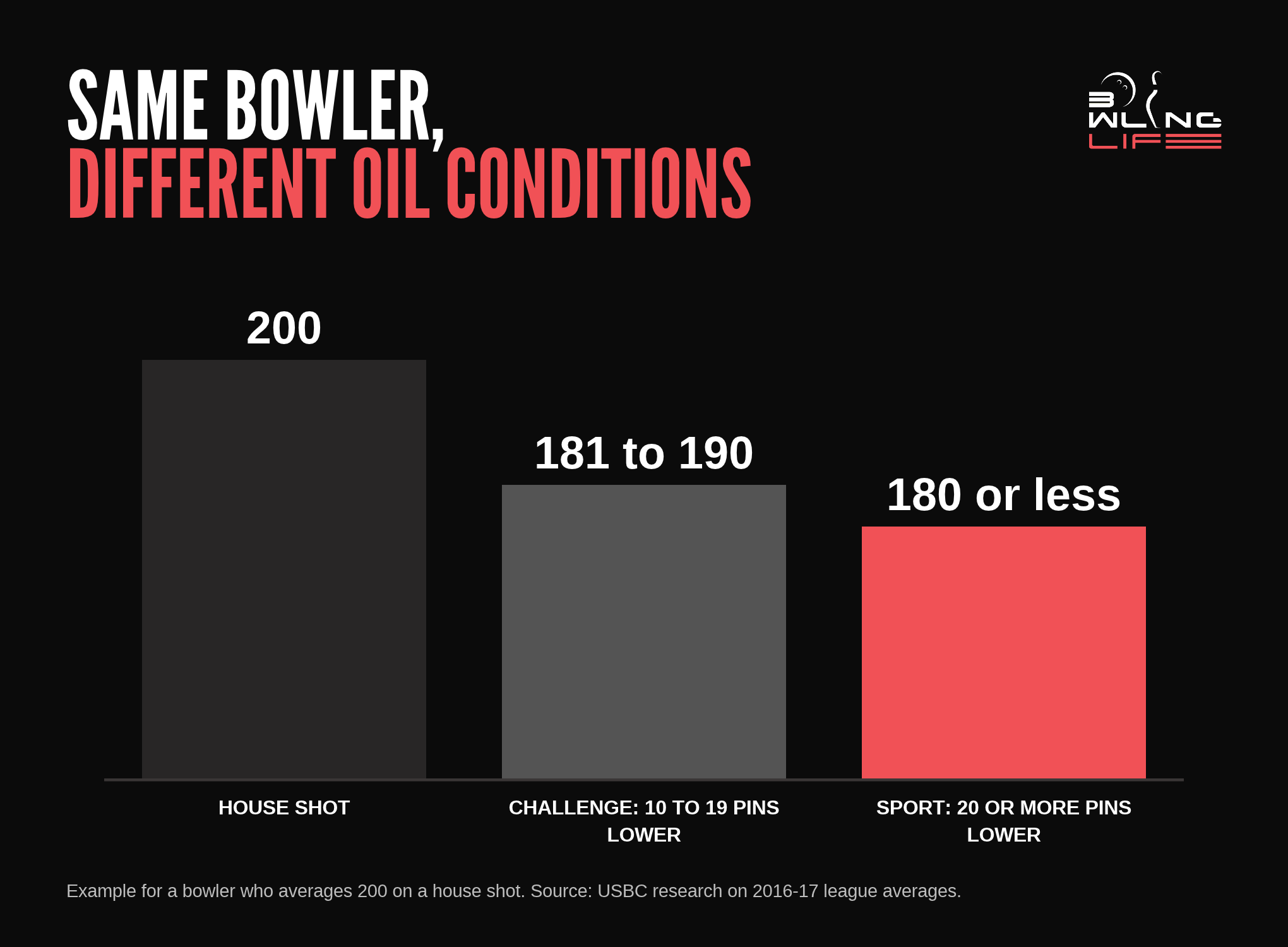
Lane oil changes scores more than most bowlers expect. USBC research found that bowlers on Sport conditions average 20 or more pins lower than on a house shot, and bowlers on Challenge conditions average 10 to 19 pins lower.
That matches my own experience. Depending on the pattern, my average could easily drop 20 pins. When we moved from league night to a tournament on a flatter pattern, my usual targets did not hold the same way, and misses that would come back on the house shot turned into splits or 10 pins. Patterns are a big part of why my own average could swing between 171 and 223 in a single season.
A typical house shot puts much more oil in the middle of the lane than on the outside boards. That creates a kind of guide: miss a little to the right and the dry boards help the ball back, miss left and the oil holds it. Sport patterns are flatter, so small misses stay misses. The oil pattern sheet tells you how much help you are getting, and our guide on how to read oil patterns explains what to look for.
USBC created the Challenge league category for the 2017-18 season and, after studying averages from 2016-17, reclassified 704 leagues: 605 as Challenge and 99 as Sport.
To compare averages fairly, USBC also publishes conversion charts. The Sport Bowling Average Adjustment Chart effective August 1, 2015 gave these values:
Sport to Standard Conversion
USBC conversion scale comparing sport league averages to house shot equivalents:
USBC's current conversion charts are on bowl.com, and the exact numbers may have changed since 2015. The point stays the same: a 190 on a Sport pattern is worth far more than a 190 on a fresh house shot.
What Do PBA Tour Players Average?
PBA Tour players average about 220 and up on patterns that are much harder than a house shot. In 2026, EJ Tackett set a PBA Tour single-season record at 229.79 over 438 games, according to the PBA.
The other nine players on the 2026 Player of the Year ballot averaged between 217.35 and 224.53. Tackett's previous two seasons were 229.37 in 2024 and 228.60 in 2025, and you can read more in our story on EJ Tackett's fourth straight Player of the Year award.
Those numbers look only slightly higher than a good league average, but they are not comparable. Tour patterns change week to week, the oil is often long or flat, and the field is the best in the world. Using the 2015 USBC chart as a rough guide, a 220 on Sport conditions sits in the same range as a house average of about 227, and many tour patterns are tougher than an ordinary Sport league.
League scores at the very top can be higher than tour scores. USBC's 2024-25 National High Average winners were Jake Washington at 253.86 over 93 games and Liz Kuhlkin at 246.39 over 120 games, with a minimum of 66 games in the same league.
How Does Handicap Use Your Average?
In most handicap leagues, a bowler gets extra pins each game based on the gap between their average and a base score set by the league. The usual formula is a percentage of the difference between your average and the base, with fractions dropped.
Leagues pick both numbers themselves. Common setups are 80% or 90% of a base like 210, 220 or 230. USBC's own example uses 100% of 220, and if a league adopts no percentage at all, 100% applies. The base should sit above the highest average in the league.
Handicap Calculation
Handicap pins awarded per game based on a 220 scratch baseline:
So a 150 bowler in a 90% of 220 league gets 63 pins a game: (220 minus 150) times 0.9 equals 63. USBC's own handicap research found that percentages such as 75%, 80% and 90% still favour the higher average team, and that even at 100% the stronger team won 70 of 100 championships in its test.
Handicap rules vary a lot between leagues and countries. In the leagues I bowled in, women got 8 pins per game, and players over 50 had their own handicap. Always check your league rules before you compare your scores with someone else's.
How to Raise Your Bowling Average by 10 to 20 Pins
The fastest way to add 10 to 20 pins is to convert more spares, then make your strike shot more repeatable. An open frame usually costs around 10 pins compared with a spare, so two fewer opens per game can be close to a 20-pin jump on its own.
- Track your numbers. Write down every game, your opens and which pins you missed. After 10 to 15 games you will see a pattern.
- Fix single-pin spares first. The 10 pin and the 7 pin are common misses. Many bowlers shoot them with a plastic spare ball thrown straight across the lane.
- Practice with a purpose. Pick one or two things for each session instead of just throwing strikes. Our coach piece on why there is no room for strikes in training explains this idea.
- Aim at the arrows, not the pins. A target 15 feet away is easier to hit than one 60 feet away. See bowling lane arrows and boards explained.
- Learn to move. When the ball starts to hook early or late, move your feet and target together. The rule of 31 is a simple starting point for where to play.
- Use your own ball. A ball drilled for your hand and style gives you a more repeatable release than a house ball.
- Bowl in a league. Regular games on the same lanes are the simplest way to build a real average.
My own practice days always had one or two goals. If it was a spare day, I shot spares. If it was a versatility day, I played different angles on the lane. And if it was light practice right before an event, I bowled just one game and focused only on my mental side and my pre-shot routine.
Spare shooting is also a mental skill. Coach Panagiotis Vardakis covers that side in spares are a feeling, not a formula. If you are just starting out, begin with how to play bowling.
Your Weekly Bowling Digest
The latest bowling news, tips, and gear reviews, all wrapped up in a quick 3-minute read delivered straight to your inbox.
Once you know where your average stands, our tips to increase your bowling average are the best next step to push it higher.
FAQ
Is 150 a good bowling average?
Yes, for a recreational or newer league bowler 150 is a good average. It means you are making a fair share of spares and avoiding many gutter balls. On our guide scale it sits between a new league bowler and a regular one.
What is the average bowling score for a beginner?
Most beginners score somewhere between 60 and 100 in their first games, which is our guide range rather than an official figure. Bumpers, house balls and a new approach all make scores vary a lot early on.
Is a 200 average good in bowling?
A 200 average is a strong number for any amateur bowler. On a typical house shot it puts you among the better bowlers in most leagues, and on a Sport pattern it is even more impressive.
How much lower are averages on sport patterns?
USBC research found that bowlers average 20 or more pins lower on Sport conditions and 10 to 19 pins lower on Challenge conditions than on a house shot. In my own experience, a 20-pin drop on a hard pattern is very normal.
How many games do you need for a bowling average?
USBC tournaments normally use an average based on at least 21 games for adults and 12 for youth bowlers. Leagues often set their own minimum for an established average, so check your league rules.
Do you round up a bowling average?
No. Under USBC league rules fractions are dropped, so a 172.9 average counts as 172. The same rule applies when handicap is calculated.
Does bowling two-handed raise your average?
Not automatically. When I switched to two-handed, my average stayed about the same. What changed was comfort: no thumb pain, fewer wrist problems and no tape to manage in the thumb hole.
What is a good bowling average for a woman?
The same bands apply to men and women, since the lanes and scoring are the same, although some leagues give women a handicap. For reference, the top USBC women's league average in 2024-25 was 246.39, by Liz Kuhlkin over 120 games.