Open my bowling bag and you will find almost as many Abralon pads as bowling balls. That is no accident. The surface of a ball changes its reaction more than most bowlers expect, and grit is how you control it.
Grit is the coarseness of the sanding pad used on a bowling ball's cover. A lower number, such as 500 or 1000, leaves a rough, dull surface that grips the lane earlier and hooks sooner. A higher number, such as 3000 or 4000, or a polish, leaves a smoother surface that skids further down the lane before it turns. Most new reactive balls leave the factory somewhere between 1000 and 5500 grit, and 2000 is one of the most common finishes.
So the number on the box tells you where in the lane the ball will start to read, not how strong the ball is.
The key thing to understand is that grit is a setting, not something fixed inside the ball. A ball's surface is whatever pad or polish touched it last, and it starts changing from the first game you bowl with it. The best thing about surfaces is that you can always bring them back. MOTIV even repeats the old saying that "surface is 70% of ball reaction".
What do the grit numbers on a bowling ball mean?
The grit number describes how fine the abrasive on the sanding pad is. Lower numbers mean bigger, rougher abrasive particles and a rougher cover. Higher numbers mean finer particles and a smoother cover.
Storm puts it simply: "lower numbers indicate rougher abrasives, while higher numbers signify smoother abrasives." It splits surfaces into low grit (80 to 360), medium grit (500 to 1000) and high grit (1500 to 4000 and above). The standard Abralon pad set most pro shops and home users work with runs in seven steps: 180, 360, 500, 1000, 2000, 3000 and 4000.
What each grit number does
Ranges overlap: the exact reaction also depends on the coverstock, the core and your own speed and revs.
Storm also measures the result. Out of the box, a 2000-grit sanded finish has a roughness average (Ra) of about 30 on a scale that can go up to around 50, according to its sanded vs shiny comparison. After polishing, the surface dropped to an Ra as low as about 2.82 in Storm's tests. That gap is why a polished ball and a sanded ball can behave like two different balls, even with the same core.
At home I use the whole range, from 360 to 4000. For the base of a resurface I mostly use 500 and 1000, which is why those two pads are always the first to wear out in my bag.

Does higher grit mean more or less hook?
Higher grit means less early hook. A smoother surface slides through the oil at the front of the lane, keeps its energy for longer and then turns later and more sharply. Lower grit means more early hook and a smoother, rounder curve.
MOTIV explains it with the "peaks and valleys" of the cover. A dull, low-grit surface has larger peaks and valleys that absorb oil and create traction, so the ball reads the lane sooner and hooks more gradually: "More tread = more hook." A polished, high-grit surface has smaller, smoother peaks, so the ball skids longer and saves that energy for the backend.
Storm saw the same thing when it tested one ball sanded and then polished on a 42-foot pattern. Sanded, the ball was controlled with a slightly softer entry angle into the pocket. Shiny, it made a more pronounced, more abrupt move at the end of the lane, and the tester generally had to move left to keep hitting the pocket. It was one ball and one bowler, but the pattern matches what most bowlers see.
- Lower grit (rougher): earlier hook, more midlane read, smoother backend, more control on heavy oil.
- Higher grit (smoother): more length, later and more angular hook, better on drier lanes.
- Polish: the most length and the sharpest turn, but also the most sensitive to dry boards.
My own rule is simple. If the conditions need the ball to get to the last part of the lane before it turns, I use polish. If I need the ball to hook early, I go lower in grit.
What grit is your ball out of the box?
It depends on the ball, and the manufacturer lists it on the spec sheet as the "factory finish" or "box finish". For sanded reactive balls, 1500 to 3000 grit is typical. For polished balls, look for 4000 to 5500 grit with polish, or a lower grit followed by polish.
Bowling.com calls 2000 grit a common out-of-box finish for dull balls, and Storm says a factory 2000-grit finish gives a balanced reaction. MOTIV gives the full spread for its own range: dull balls are typically 1000 to 3000 grit, polished balls 4000 to 5500 grit with polish.
Factory finishes as listed
Balls are named only as examples of how finishes are written, not as recommendations.
Read the finish line carefully. "1500 grit polished" does not mean the ball is rough: it was sanded to 1500 and then polished, which bowling.com describes as the shiniest finish, the one that skids longest and hooks latest. A "sheen" or "satin" finish usually means a light pass with a high-grit pad over a polish.
MOTIV's advice for its new balls is clear: "Factory finish is always the first choice." The manufacturer chose that surface to place the ball in its line-up. I always bowl a new ball at box finish first. If it doesn't suit me straight away, I change the surface to what I need. Nothing is lost, because you can always bring the factory finish back.
Which grit should you use for your lane conditions?
Match the grit to the oil: lower grit for heavy oil, around 2000 to 4000 for typical house shots, and high grit or polish for dry or burnt lanes. Your own speed and rev rate then move that choice up or down.
- High-volume oil and sport patterns: bowling.com suggests 500, 1000 or 1500 grit for earlier traction.
- Medium-volume oil and house shots: 2000, 3000 to 4000, or 1500 grit plus polish.
- Low-volume oil and burnt lanes: 4000 grit or polish, so the ball does not hook too early.
In my own bag, my benchmark ball usually sits somewhere between 1000 and 2000 grit, depending on the lanes I play. My strongest, most hooking balls are at 500 to 1000, and the ones with less surface go all the way up to 4000 polished.
Your style matters too. Storm says bowlers with lower rev rates are more likely to benefit from rough, low-grit surfaces on very oily lanes, because the extra texture does some of the work their rotation does not. Speed-dominant bowlers, who throw hard with fewer revs, usually need a duller ball so it starts earlier. Bowlers with plenty of revs or a slower ball tend to go the other way, toward higher grit, so the ball does not read the lane too soon. Our guide to bowling rev rate explains how to tell which group you are in, and the article on bowling ball speed covers the other half of that balance. If weak hits and corner pins are what made you look at your surface, our guide on why you keep leaving the 10 pin explains how the ball's reaction shows up at the pins.
If you are not sure what the oil looks like where you bowl, start with our explainer on bowling oil patterns. Grit choices only make sense once you know whether you are bowling on heavy oil or a dry house shot.
What is the difference between sanding and polishing?
Sanding cuts texture into the cover with an abrasive pad. Polishing fills and smooths that texture with a polish compound. Sanding to a lower grit adds early hook, while polishing removes early hook and adds length and backend.
The two are often combined. A ball might be sanded to 1500 or 2000 grit and then polished, which gives a different reaction from a ball sanded straight to 4000. Bowling.com's simple rule is to sand when you need an earlier hook or more midlane traction, especially on heavier oil, and to polish when you need more length or a sharper backend, typically on drier lanes.
Coverstock matters as well. Reactive resin covers react to surface changes most clearly. Urethane covers are naturally more controlled and are often used with a duller surface. Our guide to what bowling balls are made of explains the cover types, and if you bowl in USBC competition, check our report on the USBC urethane ball restrictions before you start working on an older urethane ball.
How does your ball's surface change as you bowl?
Every game changes the surface. Lane friction and oil wear the track where the ball rolls, so a sanded ball slowly loses its texture, and a polished ball can actually get rougher in the track.
MOTIV notes that a highly polished ball "will actually get rougher in the track area," and recommends refinishing dull equipment every 15 to 25 games to keep its motion consistent. Polished balls need it less often, because finer finishes hold up better. For a full resurface, the guide numbers from MOTIV and Storm are about 50 to 80 games, which our article on how often to resurface a bowling ball covers in detail.
Signs the surface has drifted away from where you want it:
- The track ring looks shinier or duller than the rest of the cover.
- The ball skids further than it used to on the same pattern, even after cleaning.
- The reaction changes from one session to the next without any change in your shot.
- You need to move further inside than you used to for the same entry angle.
Oil soaking into the cover can look like a surface problem too, so clean first. Our guide on how to clean a bowling ball at home covers cleaning and oil removal, and the ball Revivor guide explains the heated oil-extraction machine. Looking after the surface also helps the ball last longer overall, as our guide on how long a bowling ball lasts explains.
How to change your bowling ball's surface at home or at the pro shop
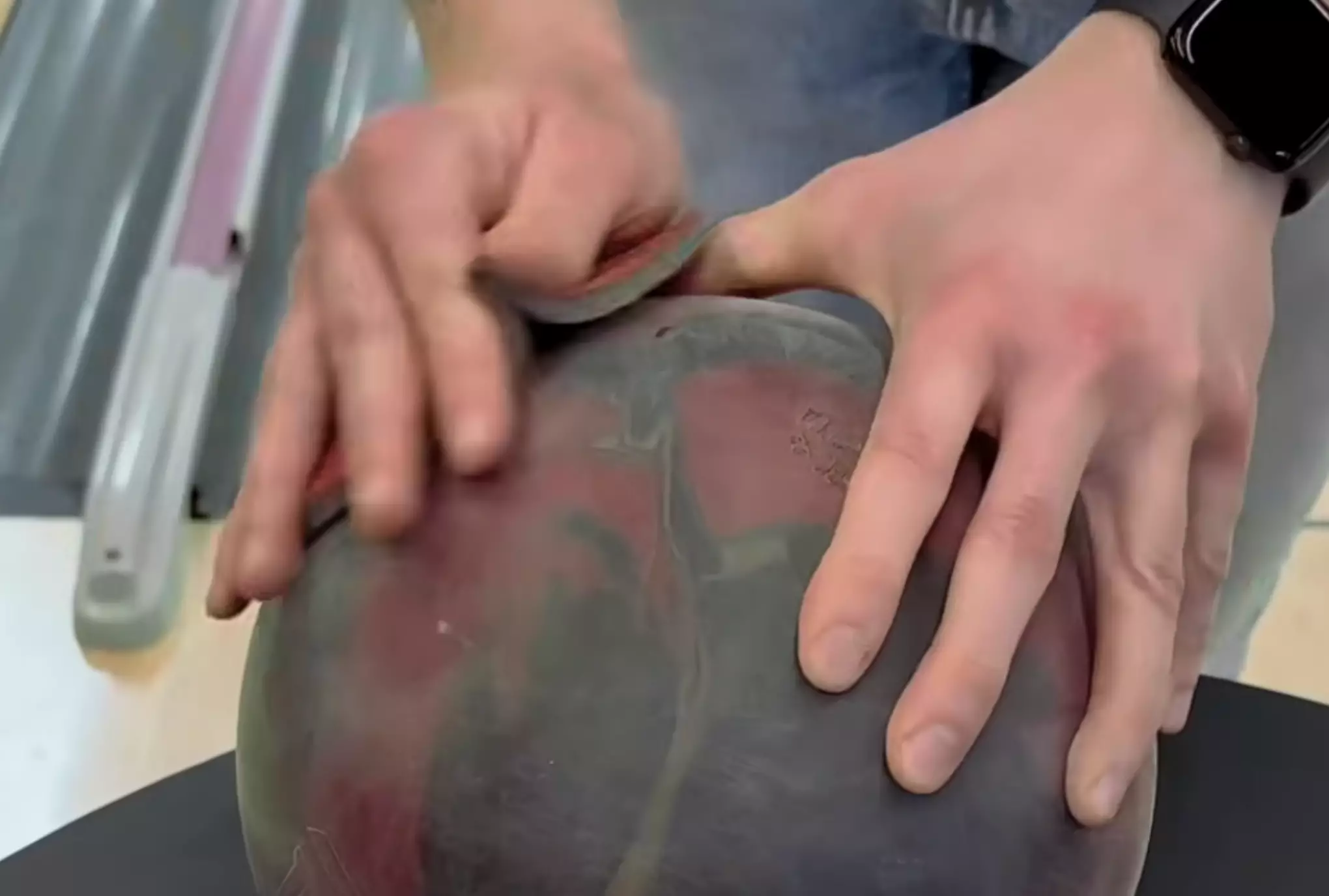
When I started bowling, I took my balls to the pro shop for every surface change. I soon found out how easy it is to do at home with a set of Abralon pads and a ball Revivor, and I have done it myself ever since. A pro shop uses the same pads with a ball spinner, which gives a more even result.
The process is the same either way: clean the ball, decide whether you want more or less hook, work through the pads one grit at a time and finish with a final clean.
- Clean the ball first with a USBC-approved cleaner. Sanding over oil only gives you a fresh surface on top of an oily cover.
- Pick the direction. More hook: go down in grit. More length: go up in grit or add polish. Storm's league guide suggests 360 to 1000 for an earlier read and 4000 to 5000 or polish for more length.
- Work in steps. To go rougher, start at the target grit. To go smoother, start one step below and work up through each pad (for example 2000, then 3000, then 4000) so each pad removes the lines of the one before.
- Keep the pads damp and cover the whole ball evenly, not just the track. Uneven sanding changes the reaction more than the grit number does.
- Be careful with very low grits. Bowling This Month notes that pads under 500 grit leave deep lines that take more work to remove.
- Polish last, if you want shine, and wipe off any residue.
- Clean again and test in practice, not in competition.
Common problems and what to try
Based on the Storm league surface guide and the bowling.com surface guide.
Can you change the surface during competition?
No. In USBC-certified play, surface changes with abrasives are allowed until the first ball is thrown in competition, as Bowling This Month's surface management guide explains, and they are generally allowed during practice. Storm gives the same practical advice: once competition begins, you are no longer allowed to change the surface. Tournament rules say the same thing, for example the 2026 Forty Frame Game rules at the USBC Open Championships: "the use of abrasives strictly is prohibited once the first ball is thrown in competition."
That is why I change surfaces before league nights and tournaments all the time. My bag is full of Abralon pads, and if a ball doesn't do what I want in practice, I change the surface until I find the right match.
I have got it wrong many times too. Not by damaging a ball, but by not finding the right surface for the conditions before the start. Once the first ball is thrown, you can't fix it, so you have to work out what the ball needs to do before the game. If you don't, you bowl with what you have.
If you are unsure, take the ball to a pro shop. They can measure the surface, take it back to factory finish and set it up for the conditions you bowl on. For the full maintenance picture, from wiping the ball between shots to a complete resurface, read our guide on how often you should resurface a bowling ball.
Your Weekly Bowling Digest
The latest bowling news, tips, and gear reviews, all wrapped up in a quick 3-minute read delivered straight to your inbox.
FAQ
Does 4000 grit hook more than 2000 grit?
No. A 4000-grit surface is smoother, so it skids further and hooks later than 2000 grit. It can look like a stronger move on the backend because it saves energy, but the early hook is less.
What grit is a polished bowling ball?
Polished balls are usually sanded to somewhere between 1500 and 5500 grit and then polished. MOTIV lists its polished balls at 4000 to 5500 grit with polish, while many other balls are finished at 1500 grit with polish.
What grit should I use for more hook?
Go lower. Bowling.com suggests 500, 1000 or 1500 grit for earlier traction, mainly on medium to heavy oil or for speed-dominant bowlers who throw fast with fewer revs.
Can I sand my bowling ball during a league night?
Not once competition starts. In USBC-certified play, surface changes with abrasives are allowed only until the first ball is thrown in competition, so make them in practice or before the series.
What is the difference between Abralon pads and sandpaper?
Abralon and similar foam-backed pads are made for curved surfaces and leave a more even finish. Bowling This Month notes that sandpaper and Scotch-Brite were widely used in the past, but Abralon and SiaAir pads are the most common today.
Should I change the grit on a new ball?
Bowl it at box finish first. MOTIV says the factory finish is always the first choice for its balls. If the ball doesn't suit you, change the surface to what you need. You can always bring the factory finish back later.