We’ve been taught to read bowling balls through numbers: RG, differential, flare potential. But there is a deeper layer - one that isn’t printed on spec sheets and is rarely discussed. A layer that lives inside the relationship between the core and the pin.
Let’s define it clearly:
Pin Axis Asymmetry - how the core’s mass is distributed relative to the pin-defined axis (the low RG axis).
This is not just about asymmetric cores . This exists in every bowling ball.
The Pin: More Than a Marker
The pin does not represent the center of the ball. It marks the orientation of the low RG axis - the axis around which the ball prefers to rotate.
So when you look at the pin, you are not just seeing position. You are seeing how the core wants to move.

Three Expressions of Pin Axis Asymmetry
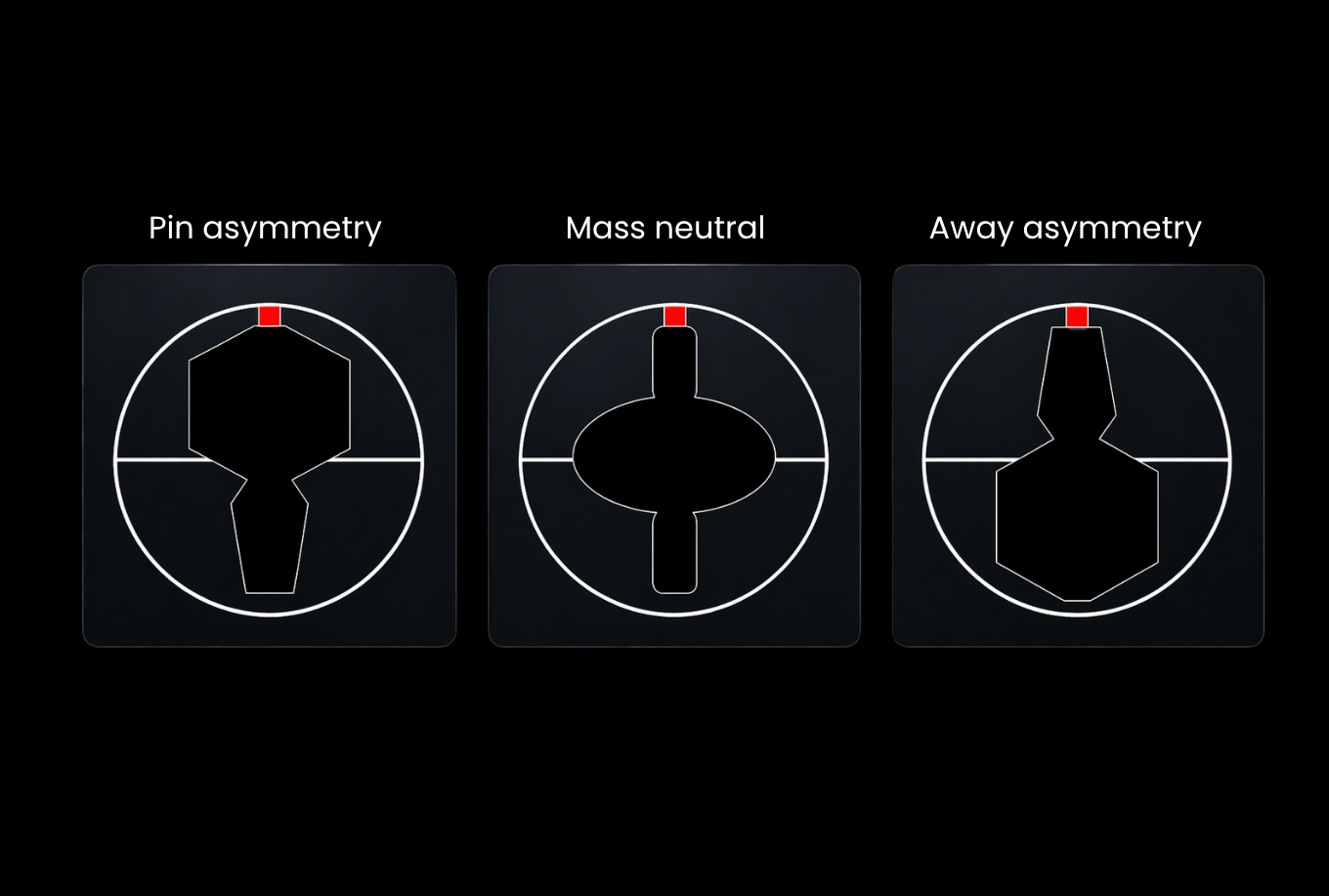
Using the visual reference above, we can describe three fundamental mass relationships.
1. Mass Concentrated Near the Pin Axis
(Compact Core Expression)
- Faster revving motion
- Earlier transition into roll
- Smooth, controlled shape
The ball stabilizes earlier and blends the lane.
2. Neutral / Centered Distribution
(Balanced Core Expression)
- Continuous motion
- Predictable transition
- Benchmark-type reaction
This creates the most readable and versatile ball motion.
3. Mass Distributed Away from the Pin Axis
(Extended Core Expression)
- Delayed revving
- Cleaner through the front
- Sharper, more angular backend
Energy is stored longer and released later.
Where Physics Meets Feel
At its core, this concept is about moment of inertia distribution.
- Mass closer to the axis → lower RG behavior → earlier motion
- Mass farther from the axis → higher RG behavior → delayed motion
But numbers alone do not tell the full story. This explains why two balls with similar specs can feel completely different.
The Dual Angle Connection
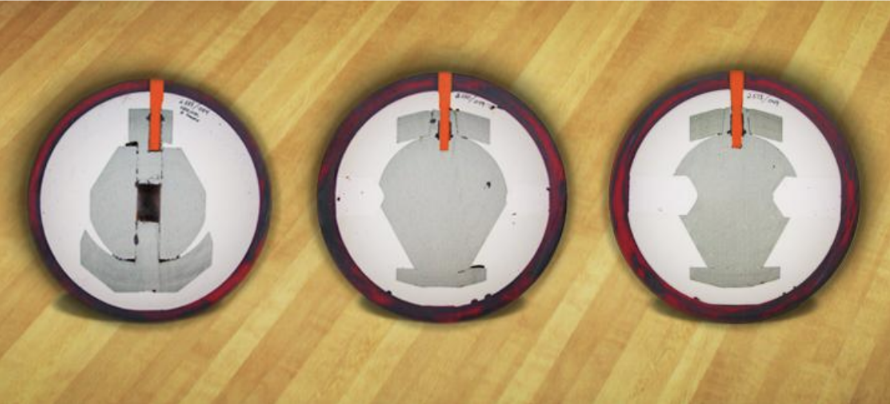
This is where the concept becomes powerful. The Dual Angle System does not just position the pin - it controls how this internal asymmetry is expressed.
Drilling Angle (First Angle)
Controls how quickly the ball transitions off the spot.
- Smaller angle → faster response → exposes earlier core motion
- Larger angle → smoother transition → delays core influence
Pin-to-PAP Distance
Determines which RG axis dominates.
- Short distance → engages low RG behavior (earlier roll)
- Long distance → shifts toward higher RG behavior (length and backend)
VAL Angle
Shapes the final motion.
- Small VAL → sharper backend
- Large VAL → smoother, more continuous motion
Your Weekly Bowling Digest
The latest bowling news, tips, and gear reviews—all wrapped up in a quick 3-minute read delivered straight to your inbox.
The Real Insight
The core provides the potential, but the Dual Angle layout determines how that potential is expressed on the lane.
When you pair a core with mass concentrated closer to the pin axis with a shorter pin-to-PAP layout, you amplify earlier motion and promote a quicker transition into roll.
In contrast, when the core’s mass is distributed farther from the pin and combined with a longer pin-to-PAP distance and a sharper VAL angle, the ball stores energy longer and produces stronger, more angular backend motion.
Why This Changes Your Perspective
This concept explains why some balls feel alive in the midlane, others feel clean but explosive downlane, and some seem to match your game perfectly.
It is not just about the published specs, and it is not just about the layout. It is the interaction between the internal mass orientation of the core and the external drilling decisions that ultimately shapes how the ball moves.
More Articles From Coach Vardakis

Final Thoughts
The pin is not just a dot. It is a reference point to something deeper - a guide to how the ball is built to move. Once you understand that, you stop guessing. You start designing motion.
The Main Takeaway
Every bowling ball has a core inside it, and the pin shows how that core prefers to rotate.
Where the mass of that core sits in relation to the pin influences how early or late the ball wants to rev. When you drill the ball using the Dual Angle system, you are deciding how that built-in potential will actually show up on the lane.
So ball motion is not just about RG numbers or layout alone. It is about how the internal design of the core works together with your drilling choices. Once you understand that connection, you stop guessing why balls react differently, even when they have similar specs.
This helps you better understand which bowling ball to choose depending on the conditions you are bowling on.