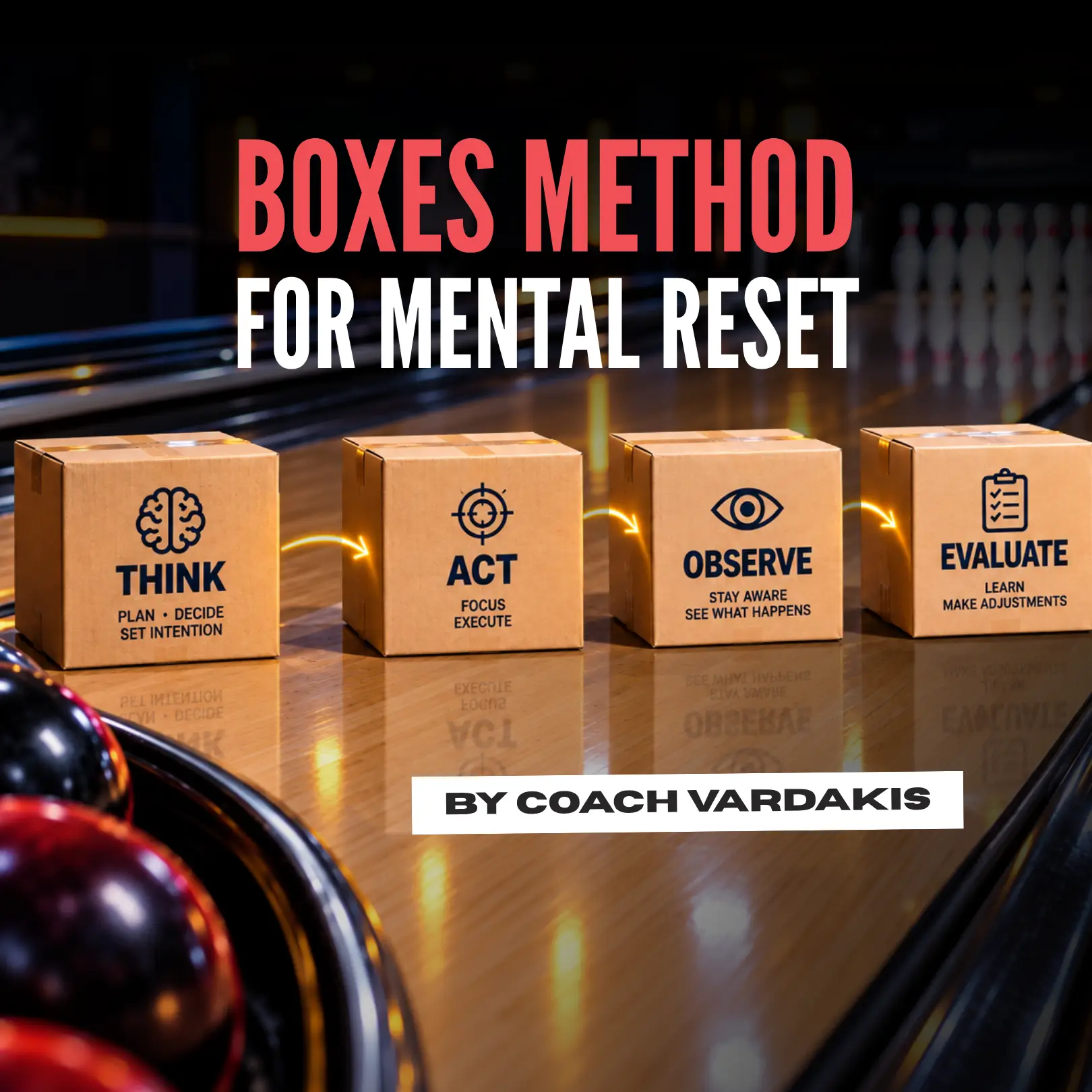
Throughout my coaching experience, I’ve made many observations about athletes’ behaviour during practice sessions and tournament days. The most common thing I’ve noticed is that all athletes, regardless of their level of experience, reach a point where they struggle to control their emotions.
The difference between a great bowler and an average bowler is rarely the ability to throw a great shot. Most competitive bowlers can do that. The difference is what happens after the bad one. A missed spare, a stressful situation, or even a perfect shot that somehow leaves a single pin standing. Some athletes carry that shot with them into the next frame, the next game, or even the rest of the tournament. Others seem to move on instantly.

Why?
As coaches, we spend countless hours helping athletes improve their physical game. We work on timing, release, footwork, targeting systems, lane play, spare shooting, and equipment choices. Yet one of the biggest factors affecting performance is often the one we spend the least time training: recovery.
Not physical recovery. Mental recovery.
Elite performers understand a simple truth: The faster you recover, the faster you perform.
Over the years, I’ve learned from various sources, often under different names, and adopted a simple mental reset process with athletes that I call the 3 R's: Recognise. Release. Rerack.

Recognise: Catch the Thought
Everything starts with awareness. Most bowlers believe their problem is the missed spare or the bad shot. Usually, it isn’t. The problem is the story they tell themselves afterward.
- "I always miss those."
- "I've thrown away the game."
- "I can't figure these lanes out."
- "I'm bowling terribly today."
The first step is simply recognising the thought. Not fighting it. Not judging it. Just noticing it. The moment you become aware of a negative thought, you take away some of its power.
You cannot control every thought that enters your mind. You can control whether it stays there. The goal is to catch the negative thought before it gains momentum. By writing down your thoughts over a period of weeks or months, you can train your mind to recognise them more easily once you understand your own thought patterns.
Release: Let Go of the Emotional Weight
Once you've recognised the thought, it's time to release it.
This is where many bowlers struggle. They replay the shot. They replay the leave. They replay the mistake.
Again. And again. And again.
Meanwhile, the next frame is approaching.
Bowling is unique because we have time between shots. That can be a gift, but it can also become a trap. This is a topic that my colleague, Coach Lenka Sulkova, and I are currently researching: how to actively use this time between frames. We hope to share the results in a future article.
The athletes who perform best learn to use that time to reset rather than replay.
Take a breath. Step away from the approach. Relax your shoulders. Trust your routine. By actively occupying your mind with specific actions, you leave less room for external distractions to creep in.
The goal isn’t to pretend the mistake didn’t happen. The goal is to stop carrying it into the next shot. Every frame deserves your full attention, not the leftovers from the previous one.
Your Weekly Bowling Digest
The latest bowling news, tips, and gear reviews—all wrapped up in a quick 3-minute read delivered straight to your inbox.
Rerack: Replace It with a Performance Thought
This is where bowling gives us the perfect metaphor. After every frame, the lane clears the deck. The machine removes what is gone. The pins are reracked. A new opportunity stands in front of you, no matter what happened in the previous frame.
Your mind should work the same way.
Reracking is the decision to start fresh. To return to your process. To focus on what you can control. To commit fully to the next shot, not the previous one. The next one. This is where performance-focused thinking begins.
Instead of: "I always miss 10-pins."
Try: "Trust the process. Execute the spare system."
Instead of: "I just gave away the match."
Try: "One shot at a time."
Instead of: "I can't strike on this pair."
Try: "Gather information. Make the next adjustment."
Every bowler talks about staying in the present. Reracking is how you do it.
Building Your Personal Rerack System
Every athlete should develop a personal reset routine. A process that tells the brain: "The last shot is finished."
For some bowlers, that may be a deep breath. For others, it may be a simple phrase. Others have a more complex system that combines mental and physical cues, such as shaking or clapping their hands, listening to music, or repeating specific phrases.
Some examples include:
- Next shot.
- Stay present.
- Commit.
- One frame at a time.
- Execute.
The exact words don’t matter. What matters is consistency. The cue should immediately bring your attention back to execution because performance happens in the present, never in the previous frame.
More Articles From Coach Vardakis

Final Thoughts
Many athletes believe mental toughness means never feeling frustrated. That’s not reality. The best athletes in the world get frustrated. They get disappointed. They get angry and nervous. The difference is that they don’t stay there.
Mental toughness is not about avoiding emotions. It’s about recovering from them faster.
Recognise
- Notice the thought.
- Notice the emotion.
- Notice the distraction.
Release
- Breathe.
- Let go.
- Leave the previous shot behind.
Rerack
- Reset mentally.
- Return to your pre-shot process.
- Prepare for the next opportunity.
Because in bowling, as in life, the next opportunity is always more important than the last mistake.