This project first came to me during a recent tournament - one of those events where it’s not just the lanes that are buzzing with action.
Tournaments are unique spaces. Coaches, athletes, and innovators come together, exchanging ideas, sharing insights, and sparking collaborations that often last far beyond the competition itself.
As a coach, I have always searched for new, innovative ways to help athletes refine their game. Over the years, I’ve experimented with everything - from single-use tools and cameras to handmade devices, and even collaborative research projects like StayinBowling initiative with Aristotle University. Each step brought me closer to understanding what really happens during a delivery, but there was still a gap.
This new in-ball sensor may finally bridge that gap. Offering insights into ball motion we’ve only been able to estimate before, it has the potential to redefine coaching, training, and performance analysis.
Today, I’m thrilled to sit down with the Witsee founder and the investor of the idea Vytautas Grigoraitis to explore how this technology works, what it can reveal, and why it could change the way we understand bowling - from the inside out.

Personal Background & Origin Story
Before we dive into the technology, can you walk us through your career journey? How did your experiences in engineering, sports science, or bowling itself lead you to this point?
My professional journey began with physics. I graduated from Vilnius
University in 1990 with a five-year university diploma equivalent to an MSc
in Physics, and since then I have been fortunate to work on a wide range of
scientific and engineering projects where precision measurement was always
at the center.
Early in my career, at the Institute of Physics, I worked on the Gardis
mercury vapor analyzer, an instrument capable of detecting as little as 0.5
picograms of mercury in the air. It was used in many research projects,
including studies of prehistoric atmosphere samples from Antarctica. Later,
I worked with the Finnish company Dekati on fine-particle measurement
technology, developing instruments able to count individual airborne
particles as small as three nanometers.
I also collaborated with
the Lithuanian laser company Ekspla on the construction of a petawatt laser
system in the Czech Republic — a laser with power measured in thousands of
trillions of watts. Today, through my company Glosendas Ltd, I continue
working with advanced technology as the developer and manufacturer of
wildlife trackers for birds and mammals.
So, my background has always been connected with measuring things that are
very difficult to measure — tiny particles, extremely small traces of
mercury, very high-power laser systems, or the movement of animals in the
wild. That experience naturally shaped the way I look at problems: I tend to
ask how something can be measured more accurately, more reliably, and in a
way that helps people make better decisions.
Sport has also been an important part of my life. I was involved in
paragliding for about 15 years, which taught me a lot about discipline,
physics, body control, and respect for small technical details. Three years
ago, together with my teenage son Emilijus, I met coach Andrius
Gasparavičius, who introduced us to what sporting bowling really is. We
started taking lessons, and I quickly realized that bowling is much deeper
than it may appear from the outside. It is a sport of technique, timing,
physics, and repeatability.
Wanting to understand more, I read Bowling Beyond the Basics by James
Freeman and Ron Hatfield. The book answered many questions, but it also
raised new ones. Around the same time, I sponsored the installation of the
Specto tracking system in our local bowling center. I was impressed by how
accurately it measured distance and speed, but I had some doubts about the
RPM measurement. That was the spark.
At first, the idea was simply to build a small tool that could measure a
bowling ball’s revolutions per minute more accurately. But as development
progressed, it became clear that the tool could do much more. Conversations
with bowlers both at home and abroad confirmed that this was not just my own
curiosity — there was real interest in better, more accessible measurement
and feedback.
So, we hired a development team, rolled up our sleeves, and got to work. A year later, we are proud to introduce what we like to call our newborn baby: a tool born from physics, engineering, curiosity, and a growing love for the sport of bowling.
Was there a specific moment or problem you encountered, either as a bowler, coach, or designer, that sparked the idea of creating an in-ball tracking sensor?
Bowling is fundamentally a psychological game. After several years as an
active player, I kept encountering performance-related questions that
neither coaches nor existing technologies could answer with full accuracy or
objectivity.
Many critical aspects of ball motion, release
consistency, and decision-making were still interpreted subjectively rather
than measured precisely.
Coming from a professional background in tracking and sensor development, I
realized that this gap was not due to a lack of expertise - but rather a
lack of the right tools. That realization became the turning point. If
accurate, real-time data could be captured directly from inside the bowling
ball, we could finally answer the most important questions bowlers and
coaches face: questions of cause and effect, consistency, and repeatability.
That insight ultimately led to the idea of creating an in-ball
tracking sensor — one capable of turning subjective assumptions into
measurable, actionable data.
Innovation in sports often comes from frustration. What was the biggest limitation you were seeing in current coaching tools that convinced you something completely new was needed?
The first major limitation was the lack of truly detailed analysis of an
individual release. From the bowler’s perspective, every shot can feel
identical at the moment of release, yet the results often vary
significantly. Existing coaching tools simply couldn’t explain why. Athletes
were left relying on perception rather than precise data.
This
limitation became even more apparent under competitive pressure. Tournament
conditions highlighted how essential it is to “polish” a release to the
point where it becomes repeatable, regardless of stress or external factors.
However, without objective measurements, achieving that level of consistency
becomes largely guesswork.
At the same time, there was a clear gap in the market. No tools could accurately measure true RPM throughout the entire motion — especially from release to impact. For many players, this is a critical parameter, yet it remains inaccessible with existing technologies. These limitations made it clear that a fundamentally new approach to coaching and performance analysis was needed.
Birth of the Idea & Development Process
Can you describe the early stages of development? What were the biggest technical or conceptual challenges you and your team faced when you first attempted to place a sensor inside a bowling ball?
In the early stages of development, we believed the biggest challenge would
be computational - ensuring the sensor could process data accurately and
deliver highly precise measurements. However, as development progressed, we
realized that the real challenge was not the calculations themselves, but
the physical integration.
Designing a sensor that could be
easily inserted and removed, remain completely unnoticeable to the player,
and - most importantly - not affect the ball’s balance or performance turned
out to be far more complex than expected.
Solving this required a deep understanding of both bowling equipment
dynamics and hardware design. I am proud that we developed a solution that
can be used in virtually any bowling ball without altering its inherent
properties. The sensor can be seamlessly installed or removed, allowing
players to switch between balls while maintaining a fully authentic playing
experience.
At the same time, we did not compromise on data quality. In addition to the ease of installation and removal, our solution delivers exceptionally accurate and reliable measurements, ensuring that the data is not only easy to access, but truly meaningful for performance analysis.
Product Presentation & Technical Explanation
For those hearing about it for the first time, how would you describe what this sensor actually does inside the ball, and what kind of data it tracks during delivery?
At its core, our sensor bridges the gap between intuition and results. In
bowling, many critical decisions are still based on feel and experience. Our
goal is to transform that intuition into measurable insight.
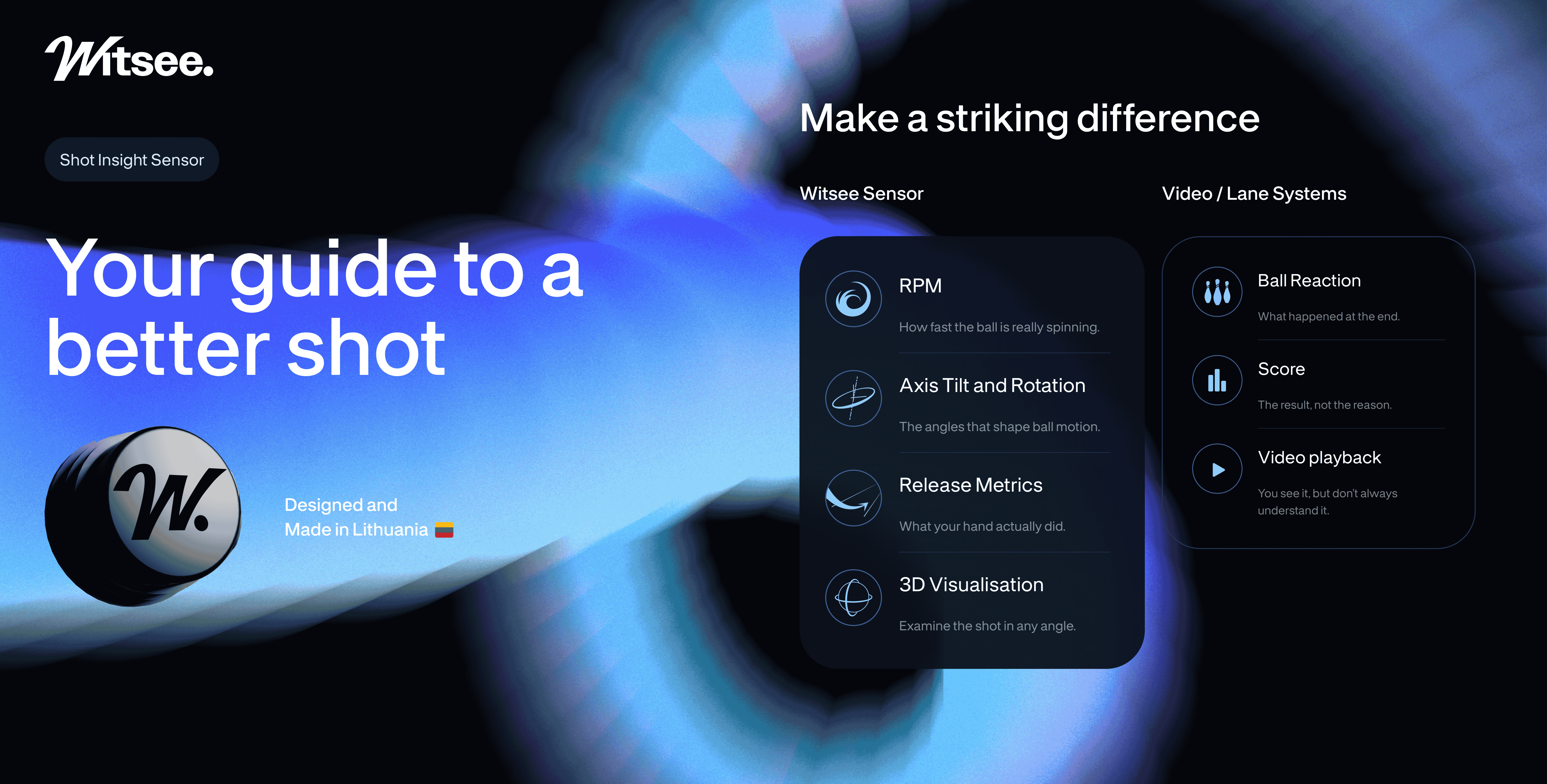
The device itself is a small, removable sensor that can be inserted into a
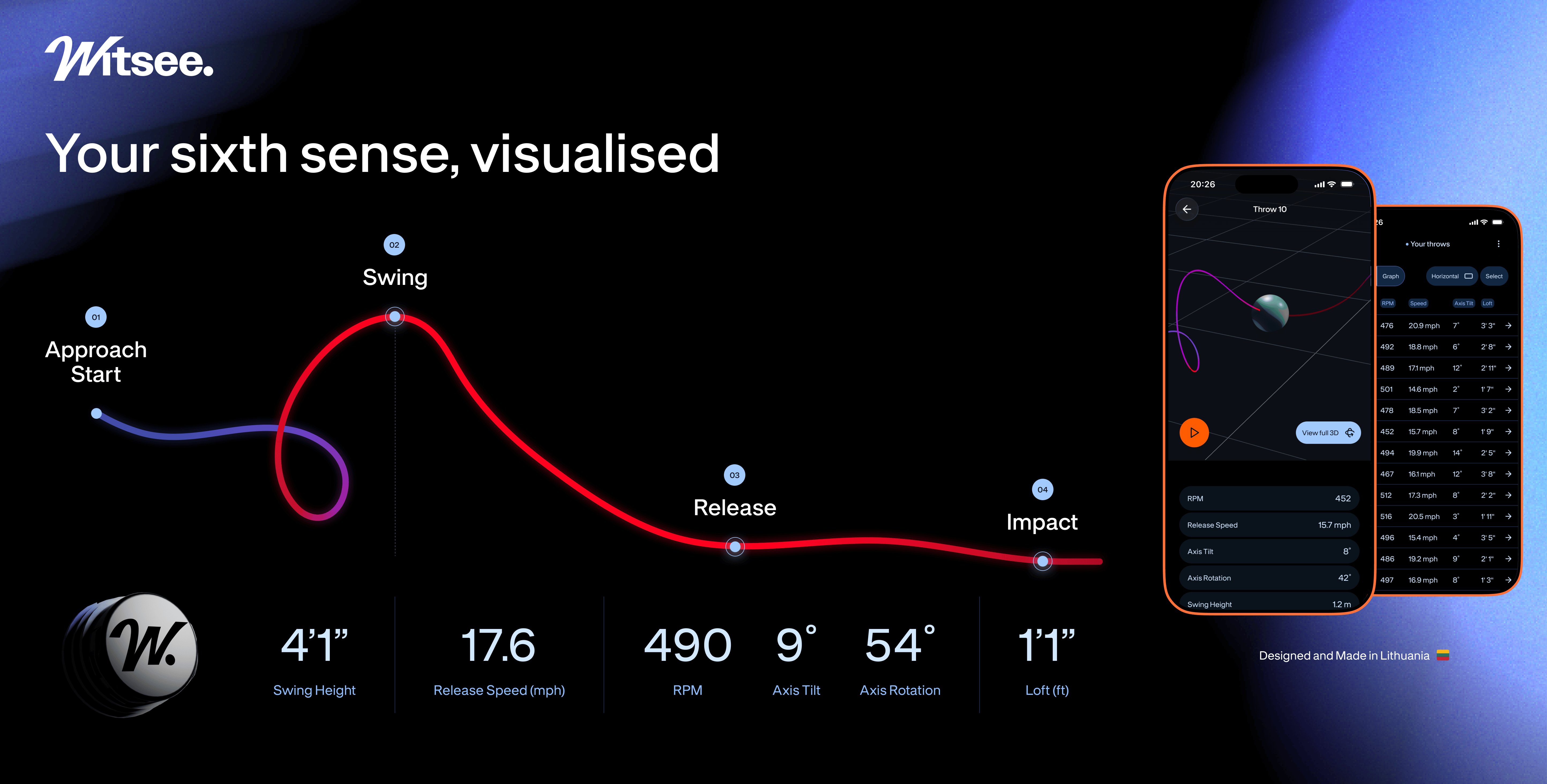
bowling ball without affecting its performance. Once inside, it tracks key
delivery parameters such as RPM, axis tilt, swing height, release speed, and
other motion dynamics throughout the shot.
All data is transmitted to a mobile app, where each delivery is visualized
in 3D environment. Players and coaches can replay, analyse, and compare
shots - making it easier to identify patterns, inconsistencies, and areas
for improvement.
In essence, the sensor turns any bowling ball into a smart training device, giving athletes greater control over their performance and helping them build a more consistent, repeatable release.
Unique metrics and insights the sensor provides beyond what existing external cameras, motion-tracking systems, or apps can accurately measure.
A closer look at how this technology can change the way we understand a bowler’s motion, using a real example from approach, to release, to impact.
Benefits, Features & Impact on Coaching/Athlete Performance
To explore that side of the project, I also spoke with Lithuanian bowling
coach Andrius Gasparavičius, whose coaching experience offers a practical look
at how this technology could be used on the lanes.
His insights
help explain how the sensor may support players and coaches in areas such as
release consistency, rotation, timing, swing analysis, and long-term player
development.
How do you envision athletes and coaches using this device in real training sessions? What practical improvements can it bring to timing, rotation, consistency, ball motion comprehension, and performance analysis?
First of all, it is important to emphasize that this device is designed to
be equally useful for players analysing their own game and for coaches
working with athletes. The data is both accurate and clearly presented.
For example, when measuring ball revs, there is no longer a need
to record the ball motion with a camera, review the footage in slow motion,
manually calculate results - a process that is both time-consuming and prone
to error. The sensor does this automatically, delivering precise results
almost instantly.
But it goes far beyond that. Whether you
want to understand your swing height, axis rotation, or axis tilt, you
receive that information after every shot — consistently and objectively.
What long-term impact do you believe this technology will have on player development, coaching methodology, and even ball design in the bowling industry?
Compared to all the existing solutions on the market, I believe this
technology represents a significant step forward in accessing data that is
currently either estimated or requires considerable time and effort to
measure.
Many modern bowling centres are equipped with the
widely popular Specto system. In my view, this device will complement it by
providing much-needed data of the shot before and after the foul line -
including free swing dynamics, axis tilt, axis rotation, swing height,
revolutions, and other key parameters.
By combining these data
points, players and coaches can gain a much more complete understanding of
the entire shot.
For coaches who may feel overwhelmed by data, how does your system make information readable, accessible, and useful on the lanes?
The system is designed not only to provide numerical values, but also to
make those values easy to understand. In addition to raw data, it visualizes
the ball’s motion throughout the swing, the axis of rotation, and how it
evolves up to the moment of release.
This means that users who prefer a more visual approach - rather than purely
numerical analysis - can still fully understand what is happening during
each shot.
Our goal is to present complex information in a simple, intuitive way, so that it becomes immediately useful during training, not something that requires additional interpretation later.
As a coach, how would you assess whether this device is best suited only for professional players, or also for beginners?
One of the key advantages of this device is its versatility — it can be used
by beginners, advanced players, and coaches alike. Beginners usually focus
on developing fundamental skills such as a free swing (for one-handed
players), the ability to generate rotation, make it consistent, or adjust it
as needed. With this tool, they can immediately see whether they are
achieving those goals.
More advanced players, for example those working on changing axis rotation,
can track their progress after every throw and objectively evaluate how well
they are executing adjustments.
For coaches, the value lies in identifying areas that need improvement and then monitoring how effectively those changes are being implemented over time.
Your Weekly Bowling Digest
The latest bowling news, tips, and gear reviews—all wrapped up in a quick 3-minute read delivered straight to your inbox.
Closing & Subtle Affirmation
In every major technical leap there are collaborators who quietly accelerate progress, who would you think was unexpectedly important to getting this product over the line, and why?
We are deeply grateful to a wide group of contributors whose expertise
quietly but significantly accelerated the development of this product.
Coaches, players, and bowling experts played a crucial role in helping us
ask the right questions and validate our assumptions throughout the process.
Without their real-world insight, achieving meaningful results would have
been far more difficult.
In particular, experienced coaches such as Michael Bai, Andrius
Gasparavicius, and Ron Hatfield had an unexpectedly strong impact. Their
deep understanding of the game helped us identify which data points truly
matter - both for athletes striving to improve and for coaches guiding that
process. They were instrumental in transforming raw sensor data into
insights that are relevant, practical, and actionable.
Additionally, our collaboration with the USBC played a key role in bringing
the product to completion. It allowed us to test and validate the device
under real bowling conditions, ensuring that the data is accurate and
aligned with industry standards.
This combination of expert insight and formal validation was essential in turning a promising concept into a reliable, performance-ready solution.
More Articles From Coach Vardakis

Final Statement from the Interviewer
As a coach who has spent many years searching for tools that reveal the
invisible parts of a bowler’s game, this sensor represents a breakthrough I’ve
been waiting for.
The ability to see what truly happens inside the
ball - not just on video or on the lane surface, but within the motion itself
- has the potential to redefine how we train, teach, and understand
performance.
I’m genuinely excited to bring this technology into
my own coaching sessions and integrate it into the development of the athletes
I work with.