Most adults burn roughly 200 to 300 calories an hour of bowling, which works out to about 50 to 65 calories for a game bowled alone and 200 to 300 for a game shared by four people on one lane. The 2024 Compendium of Physical Activities puts bowling at 3.0 to 3.8 METs. At the top of that range, it matches walking at a moderate pace.
The real number depends on two things: how much you weigh and how long you spend on the lane. A heavier bowler burns more for the same game, and a game that takes an hour burns more than one that takes 15 minutes, even if most of that hour is spent sitting down.
That is the key idea behind every calorie figure in bowling: you pay for time, not for frames. A game is between 11 and 21 deliveries whoever bowls it, so the calories come from the walk, the slide, the swing and the waiting in between. If you want a broader look at what the sport does for your body, our guide to the health benefits of bowling covers heart health, balance and the social side.
How Many Calories Does One Game of Bowling Burn?
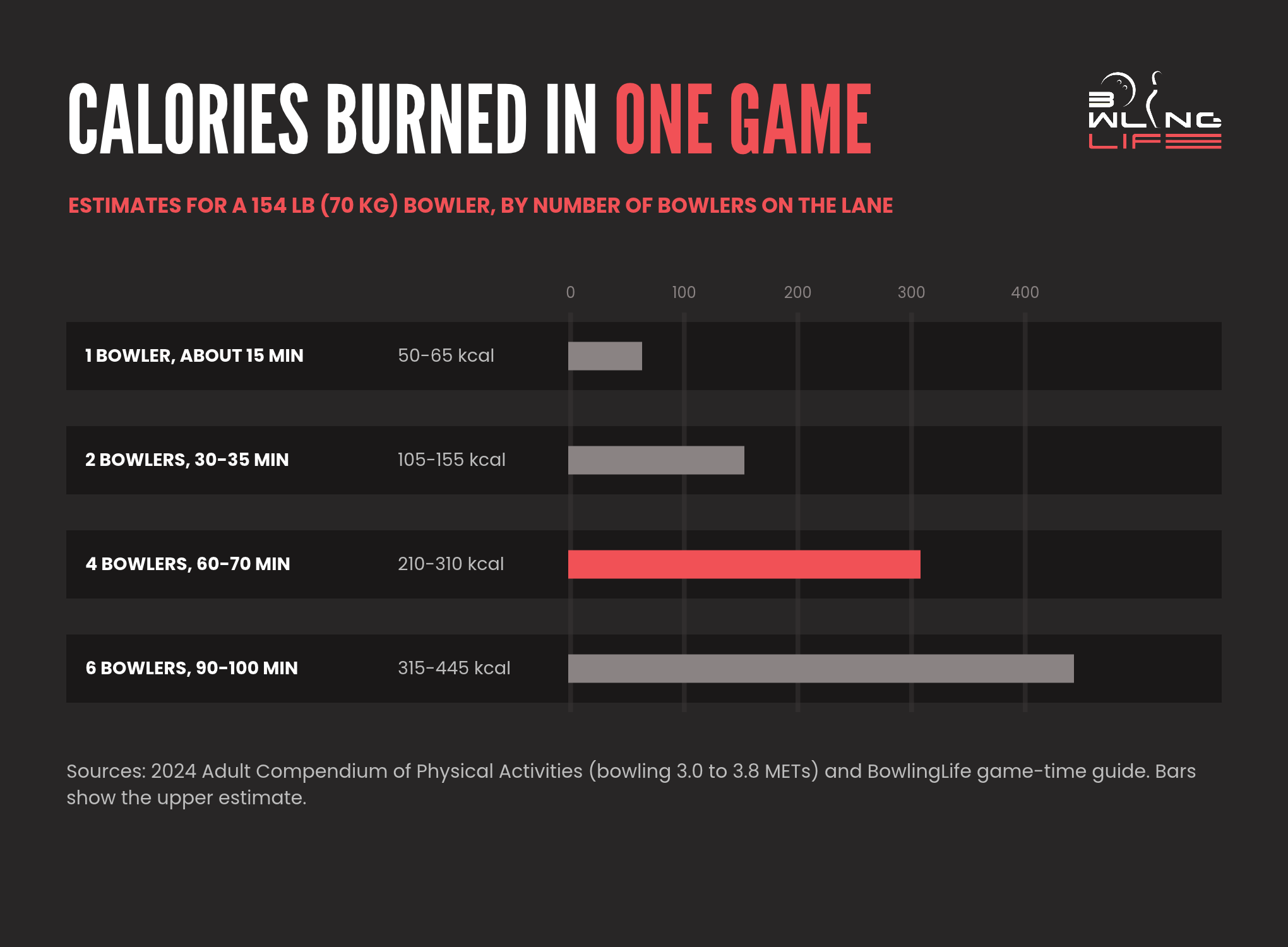
One game burns about 50 to 65 calories when you bowl alone and about 200 to 300 when four bowlers share a lane, for a 70 kg (154 lb) adult. The difference is simply time: a solo game takes about 15 minutes, while a game for four takes 60 to 70 minutes.
We used the game times from our guide on how long a game of bowling takes and multiplied them by the Compendium's values for bowling (3.0 to 3.8 METs). In bigger groups you spend more of each game sitting, so the true figure is closer to the low end of each range.
Bowling alone is the most active way to bowl, because you are back on the approach every minute or so. Solo practice can tire me more in the short term when I bowl game after game, but that rarely happens. Over a whole evening, league nights tire me more, and the section on league nights below explains why.
How Many Calories Does Bowling Burn Per Hour?
Per hour, bowling burns about 165 to 210 calories for a 55 kg (121 lb) adult, 210 to 265 for 70 kg (154 lb), 255 to 325 for 85 kg (187 lb) and 300 to 380 for 100 kg (220 lb). These are estimates, not measurements of your own body.
The numbers come from MET values. One MET is the energy you use sitting at rest, roughly 1 calorie per kilogram of body weight per hour, according to the 2024 Adult Compendium of Physical Activities published in the Journal of Sport and Health Science. The Compendium's sports list puts bowling at 3.0 to 3.8 METs. Multiply the MET value by your weight in kilograms and you get calories per hour.
Bowling Calories by Body Weight
Estimates from the 2024 Compendium of Physical Activities: METs x body weight in kg = calories per hour.
Harvard Health's widely shared table lands at the lower end of that range: 90 calories in 30 minutes of bowling for a 125-pound person and 108 for a 155-pound person, or about 180 and 216 an hour (Harvard Health Publishing). That matches the bottom of the Compendium range. If you have seen "150 to 300 calories an hour" elsewhere, including in our own older articles, it fits the Compendium numbers for most adult body weights.
Two caveats are worth knowing. First, these are gross calories: they include the energy you would burn anyway sitting on the sofa. For a 70 kg (154 lb) bowler that is about 70 calories an hour, so the extra burn from bowling is closer to 140 to 195 calories an hour. Second, a fitness watch may show a different number. Bowling mixes short bursts of movement with long pauses, which is not the steady activity most watches are built to measure.
Does Bowling Burn More Calories Than Walking?
No, but it comes close to an easy walk. At the top of its range (3.8 METs), bowling matches walking at 2.8 to 3.4 mph on flat ground, while a brisk walk at 3.5 to 3.9 mph is rated 4.8 METs (Compendium walking list).
The catch is that bowling only reaches that level when you keep moving. An hour of walking is an hour of walking. An hour of bowling with three friends includes a lot of standing at the ball return and sitting at the scorer's table. Here is how the main options compare for a 70 kg (154 lb) adult.
So bowling sits above billiards (about 175 calories an hour), around a moderate walk (about 265) and below golf if you walk the course carrying your clubs (about 300). It is not a replacement for a run, but it is far from sitting still.

Is Bowling Moderate-Intensity Exercise?
Yes, just. The Compendium classes anything from 3.0 to 5.9 METs as moderate intensity, and bowling's 3.0 to 3.8 METs fall inside that band, though at the bottom of it.
That matters if you are counting activity minutes. The World Health Organization recommends that adults get at least 150 to 300 minutes of moderate-intensity aerobic activity a week, plus muscle-strengthening work on two or more days. A weekly league night can count toward the aerobic target, but only the time you are actually up and moving, not the time spent waiting for your turn.
The strength side is real too. The USBC's coaching guide on physical fitness for bowlers says bowling uses every major muscle in the body. It points to the legs for ball speed and balance at the foul line, and to strong shoulders to handle the forces the ball creates during the swing. Lifting a 12 to 16 pound ball dozens of times a night works the bowling arm, grip and core, which is also why a ball that is too heavy shows up as soreness. Our bowling ball weight guide explains how to pick a weight your body can handle all night.

How Many Calories Does a League Night Burn?
A three-hour league night burns roughly 630 to 800 calories for a 70 kg (154 lb) bowler, or about 420 to 590 calories more than sitting at home for the same time.
League nights vary a lot. A three-game night with several bowlers per team on a pair of lanes often runs two and a half to three hours, and in my experience it can easily stretch to three or four. Because league bowlers spend much of the evening seated between shots, treat the low end of each range as the realistic figure.
Calories on a League Night (154 lb Bowler)
League nights tire me more than solo practice. The stress, the thinking and the long games all add up. Not all of that tiredness is calories, though. Concentrating on every shot for three or four hours wears you out even when your body is not working especially hard.
What Affects How Many Calories You Burn Bowling?
Body weight and time on the lane matter most, followed by how much you move between shots. Everything else is small by comparison.
- Body weight. Calories scale directly with weight. A 220 lb (100 kg) bowler burns about 40% more than a 154 lb (70 kg) bowler doing exactly the same thing.
- Bowlers per lane. Fewer bowlers means more deliveries per hour and less sitting. Bowling alone can mean four games an hour; with six on a lane, one game can take 90 minutes or more.
- Pace. Getting up as soon as the pinsetter clears and walking back briskly keeps you near the top of the range.
- Standing or sitting. Standing burns a little more than sitting, and over a three-hour night that adds up.
- Ball weight and style. A heavier ball and a more athletic approach add load, but the effect on calories is small. Do not go up in ball weight to burn more: that is how wrists and shoulders get hurt.
- Warm-up and practice. Stretching before you bowl and a few practice shots add a few minutes of real movement to every session.
How Can You Burn More Calories While Bowling?
The easiest way to burn more is to spend more of your lane time moving. You do not need to change your game, only what you do between shots.
- Bowl with fewer people per lane. Two lanes for a group of eight means twice the deliveries per hour for everyone, and the night finishes sooner too.
- Book a solo practice session. Four or five games on your own is the most active hour bowling offers.
- Stay on your feet. Stand at the ball return or behind the approach instead of sitting down after every shot.
- Warm up properly. A few minutes of mobility work before the first game. The USBC fitness guide recommends dynamic stretches for the warm-up and static stretches held for 15 to 30 seconds as a cool-down.
- Carry your own gear. Walking in from the parking lot with a one- or two-ball bag is small, but it is real effort.
- Add strength work on non-bowling days. Squats and lunges for the legs, and pull-ups and seated rows for the shoulders, are the exercises the USBC guide suggests. They make long nights easier and protect your joints.
My own warm-up is simple: basic stretches for my wrist, elbow and shoulder, then dynamic movements for my knees, hips and torso. It takes a few minutes and gets the whole chain moving before the first practice ball.
Can Bowling Help You Lose Weight?
It can help, but it will not do it on its own. An extra 420 to 590 calories over a three-hour league night is real, but it is easy to eat back with a basket of fries and a drink at the lanes.
Where bowling helps is consistency. A weekly league is an evening of light activity that people actually keep doing for years, and it keeps your legs, core and balance working. If you carry extra weight and bowl regularly, it also pays to look after your knees: our guide on preventing bowling knee pain explains why body weight and the slide put so much load on that joint. Back and shoulder problems are covered in our bowling back pain guide and bowling shoulder pain guide.
Food choices matter as much as the bowling itself. On long tournament days, our meal plan for tournament bowlers and our performance nutrition tips cover what to eat to keep your energy steady without overeating. My own lane snacks are fruit or a little dark chocolate, and I drink only still water or an isotonic drink.
Your Weekly Bowling Digest
The latest bowling news, tips, and gear reviews, all wrapped up in a quick 3-minute read delivered straight to your inbox.
If you want to keep track of your progress on the lanes as well as off them, our guide to what a good bowling average is gives benchmarks from beginner to pro.
FAQ
How many calories do you burn bowling 3 games?
It depends on how long the three games take. Bowling alone, three games take about 45 minutes and burn roughly 160 to 200 calories for a 154 lb (70 kg) adult. In a league, three games often take two and a half to three hours and burn roughly 525 to 800 calories, most of it at a resting pace.
How many calories does 1 hour of bowling burn?
About 210 to 265 calories for a 154 lb (70 kg) adult, based on the Compendium's 3.0 to 3.8 MET values for bowling. Lighter bowlers burn less and heavier bowlers more, from about 165 calories at 121 lb (55 kg) to about 380 at 220 lb (100 kg).
Is bowling a good workout?
It is light to moderate exercise rather than a hard workout. The Compendium places it at the bottom of the moderate-intensity range, and it works the legs, core and bowling arm. It is a good way to stay active, especially if you bowl often, but it does not replace brisk walking, running or strength training.
Do you burn more calories bowling with a heavier ball?
Only slightly. The extra calories from a pound or two more ball weight are small, while the extra load on your wrist, elbow and shoulder is not. Choose the ball weight you can control for a full session.
Does bowling count toward 150 minutes of exercise a week?
The time you spend actively bowling does, because bowling falls in the moderate-intensity band (3.0 METs and above). Time spent sitting between frames does not, so a two-and-a-half-hour league night might count for well under half that.
Why does my fitness watch show so few calories for bowling?
Most watches estimate calories from heart rate and movement. Bowling mixes short bursts of movement with long pauses, so the heart rate rarely stays up for long. Treat both your watch and the figures in this guide as estimates. I have not tracked a bowling session with a watch myself yet, but it is on my list.